
McmcSaemCompatibleModel#
Module: leaspy.models.mcmc_saem_compatible
Inherits from: StatefulModel
McmcSaemCompatibleModel is the bridge between the generic MCMC-SAEM algorithm and a specific mathematical model. While StatefulModel provides the variables (the State), this class defines the interface and methods required to optimize them.
It guarantees that the algorithm can perform its two main iterative steps without knowing the underlying model details:
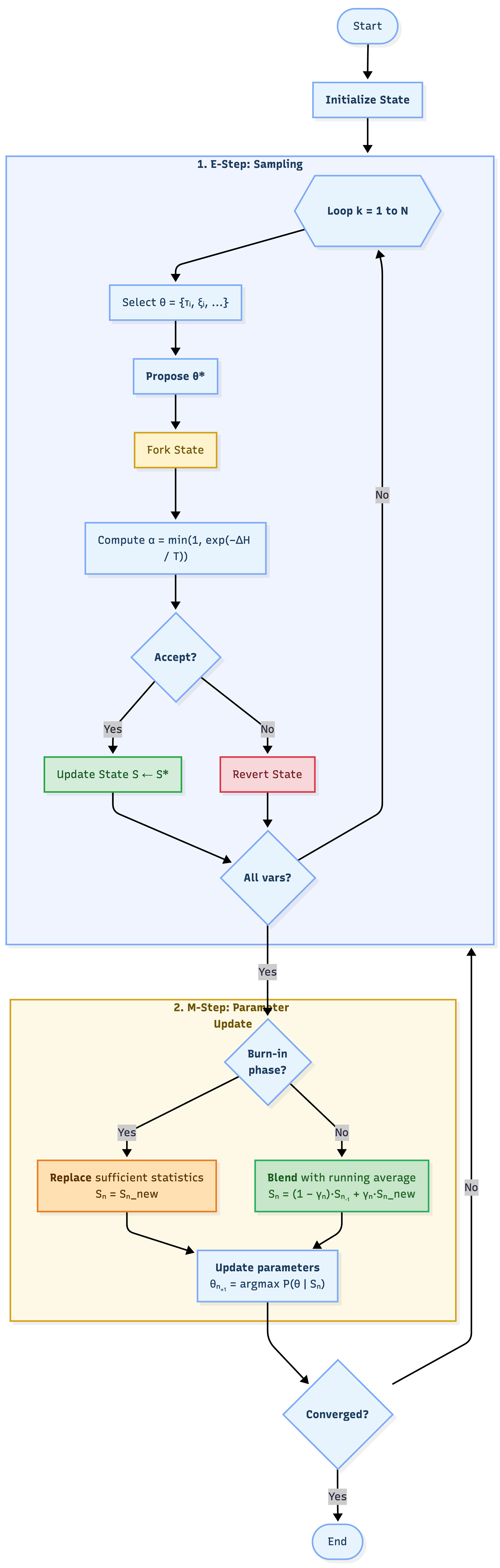
E-Step: Sampling individual latent variables (like \(\tau_i, \xi_i\)).
M-Step: Updating population parameters (like \(g, v_0\)).
The Optimization Contract#
The class enforces three core methods that drive the MCMC-SAEM loop:
put_individual_parameters(state, dataset)(E-Step) Used to initialize or inject individual latent variables into the state. Concrete models (likeLogisticModel) implement this to map the dataset inputs into the model’s specific latent variables.compute_sufficient_statistics(state)(M-Step, Part 1) After sampling, the algorithm needs to summarize the current state. This method aggregates sufficient statistics from allModelParameternodes in the DAG. It computes the minimal set of numbers (sums, counts) needed to update parameters, rather than storing every sample.update_parameters(state, sufficient_statistics, burn_in)(M-Step, Part 2) Updates the population parameters using the computed statistics. This is done in a batch operation: all new values are computed first, then applied simultaneously to avoid order-dependent inconsistencies.
Burn-in vs Maximization#
The MCMC-SAEM loop is split into two sequential phases — burn-in runs first, then maximization takes over for the remaining iterations:
Burn-in phase (default: first 90% of iterations): Uses a memoryless update rule — each iteration’s sufficient statistics directly replace the previous values. This allows the algorithm to move quickly toward a good region of the parameter space without being held back by poor early estimates.
Maximization phase (remaining iterations): Switches to recursive averaging (the “SA” in SAEM), where new statistics are blended with a running average using a decaying step size. This produces more stable, converged parameter estimates.
The split is configured via n_burn_in_iter_frac (default 0.9, i.e. 90% burn-in). It can be passed directly to model.fit():
model.fit(data, "mcmc_saem", n_burn_in_iter_frac=0.8)
Other Responsibilities#
Beyond the optimization loop, this class handles:
Observation Models: Wraps the noise model (e.g., Gaussian noise), providing the likelihood function (
nll_attach) needed to accept or reject samples.Individual Trajectories: The
compute_individual_trajectorymethod allows predicting a patient’s score after the model is trained, effectively powering thepersonalizefeature.
The Algorithm Loop#
The following diagram illustrates how the MCMC-SAEM algorithm interacts with this interface at each iteration:
With the optimization interface defined, the next step is to see how concrete models build on it — starting with TimeReparametrizedModel, which adds the time-shifting mechanism shared by all temporal models in Leaspy.